
Pickleball Kitchen Momentum Rule: When Is It a Fault?
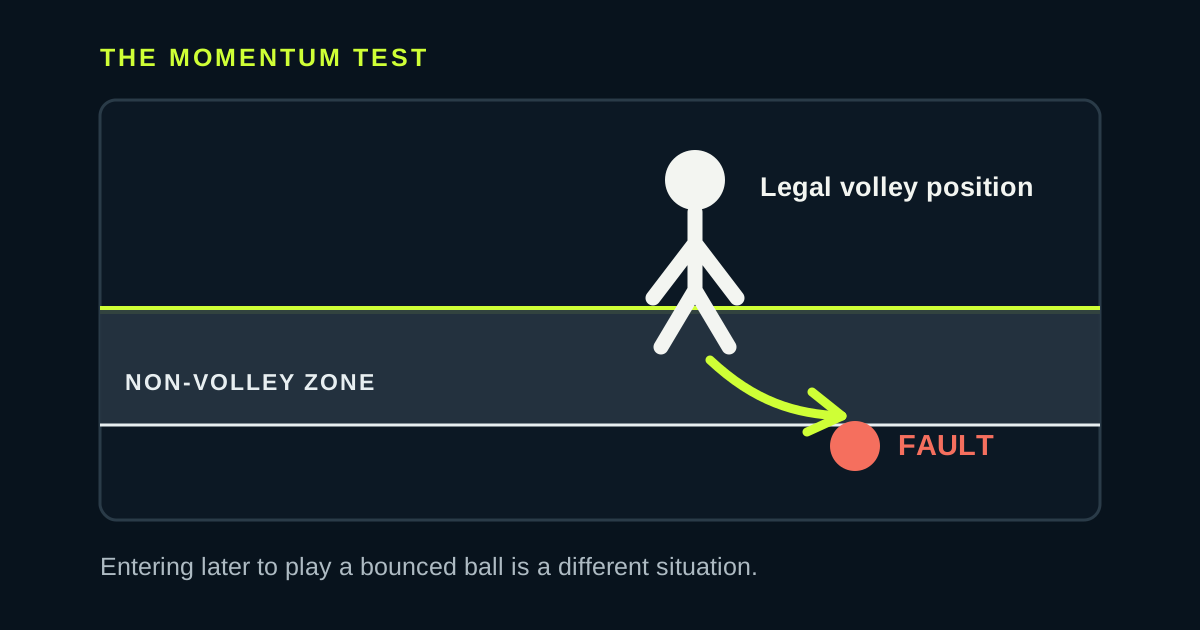
If you volley the ball, your momentum cannot carry you into the non-volley zone. The fault still applies if the ball becomes dead first. Once you regain balance and control or stop moving toward the kitchen, that volley's momentum has ended.
The decision table
| What happens? | Ruling |
|---|---|
| You volley from outside, then step on the kitchen line before regaining balance | Fault. The line is part of the non-volley zone. |
| You hit a winning volley; the ball becomes dead; your momentum then carries you into the kitchen | Fault. The momentum exception continues after the dead ball. |
| You volley, regain balance and control outside, then later step into the kitchen | Legal. The later step is not part of the volley momentum. |
| Your volley momentum carries you into a partner who is touching the kitchen | Fault. Your momentum caused contact with something touching the zone. |
| Your partner stands in the kitchen while you volley outside, but you do not contact them | Legal. Their position alone does not create your fault. |
| The ball bounces before you hit it while standing in the kitchen | Legal under the NVZ rule. The shot is not a volley. |
| You jump from inside the kitchen and volley before both feet land completely outside | Fault. This is failure to re-establish outside under Rule 11.A.3. |
The exact test for when momentum ends
The 2026 USA Pickleball rulebook defines momentum as the motion that causes a player to keep moving after contacting the ball. For a volley, it ends when either of two things happens:
- the player regains balance and control of their motion; or
- the player stops moving toward the non-volley zone.
There is no fixed one-second, two-step or “next shot” test. A long attempt to recover can still belong to the same volley. A short pause does not automatically prove control. The practical question is whether the player's later kitchen contact was still caused by the volleying movement.
Why the dead ball does not save the volleyer
Most faults occur only while the ball is live. Kitchen momentum is the named exception. Rule 9.B.1 points directly to the non-volley-zone momentum rule, and Rule 11.A.2 says the fault applies even after the ball becomes dead.
That means a clean winner is not complete for the volleyer until the player's momentum is under control. If the ball bounces twice, lands out or otherwise becomes dead, then the volleyer falls onto the kitchen line from the same forward motion, the volleyer committed the fault.
Contact can be direct or through something else
The obvious case is a shoe touching the kitchen or its boundary line. The rule is broader. If the volleying player contacts something that is touching the non-volley zone—including a partner—and the volley momentum caused that contact, it is a fault against the volleying player.
Rule 11.A.1 also covers the player and anything in contact with the player during the act of volleying. A hand, paddle or clothing touching the zone can therefore create the same result; the rule is not limited to feet.
A bounced ball changes the analysis
A volley is a ball struck before it bounces. If the ball bounces first, you may step into the kitchen and hit it from there. Forward movement after that groundstroke is not a kitchen volley-momentum fault, although another rule could still decide the rally.
This is why “you stepped into the kitchen” is never enough information. The essential first question is: did you volley the ball?
Stepping in later can be legal
The kitchen is not prohibited territory. After the momentum from a legal volley has ended, a player may enter the zone. A later step to play a dink, change position or retrieve a dead ball does not retroactively invalidate the volley.
The cleanest evidence is visible control outside the zone: balanced posture, an independent change of movement, or an unmistakable stop before the later step. The rulebook's actual definition—not a player's declaration that they “had control”—decides the call.
Leaving the kitchen is a separate rule
A player who has contacted the non-volley zone must establish both feet completely outside it before volleying. Jumping from inside the kitchen and striking the ball before landing outside is a fault even if the player eventually lands safely beyond the line.
That is Rule 11.A.3, not the post-volley momentum rule. The full kitchen rules guide covers entry, the boundary line, reaching over the zone and re-establishing outside.
Who calls a momentum fault in recreational play?
In a game without officials, players are expected to call faults on themselves or their partner as soon as the fault is committed or detected. An opponent may also call a non-volley-zone fault. The call must be made before the next rally's serve is hit.
If the teams disagree about the opponent's kitchen-fault call, the rally is replayed. If partners disagree about a fault call, the decision goes in favor of their opponents. Those procedures come from Rules 9.B.2 and 9.B.3; they are not the same as ordinary line-call responsibility.
Bottom line
After a volley, stay clear of the kitchen until you regain balance and control or stop moving toward it. If that same motion carries you, your equipment or your contact with another person or object into the zone, it is a fault—even after the ball is dead.
Primary source
Checked August 15, 2026. This page applies the current USA Pickleball rules. Tournament or professional-tour rules can differ; the governing rules for the event control.