
Pickleball Court Dimensions 2026: 20 × 44 Feet
A regulation pickleball court is 20 feet wide and 44 feet long for both singles and doubles. The kitchen extends 7 feet from the net on each side; the net is 36 inches high at the sidelines and 34 inches at the center.
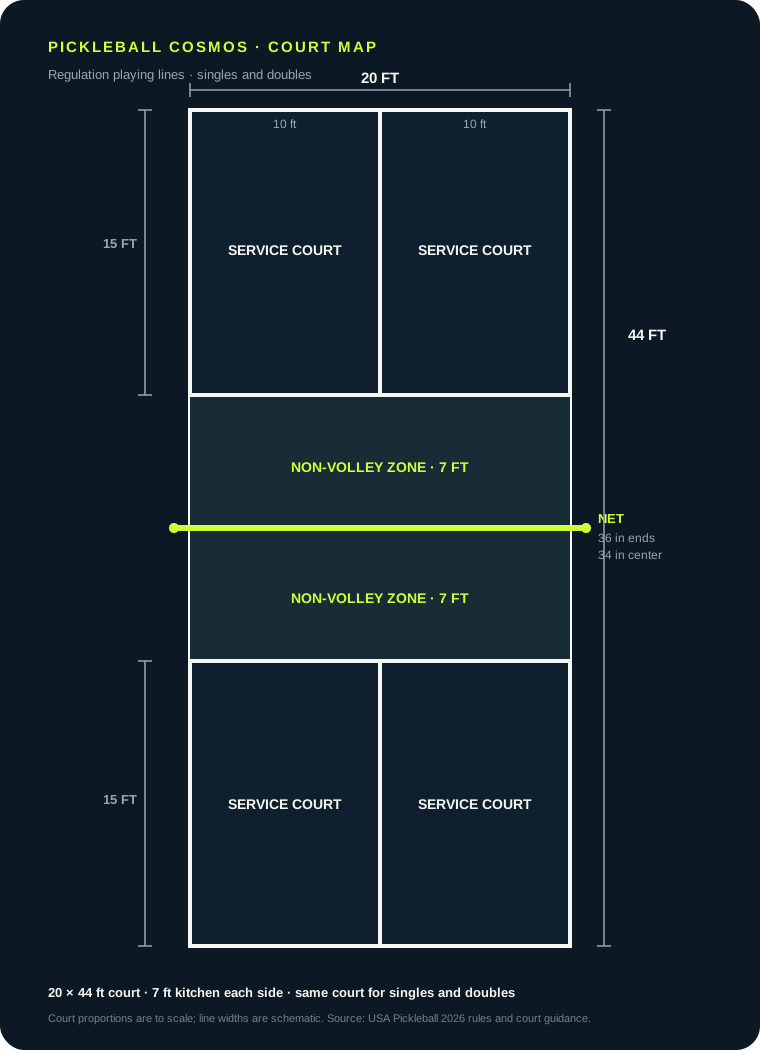
Official court dimensions at a glance
| Element | Official / standard dimension | What it means |
|---|---|---|
| Playing court | 20 ft × 44 ft | Same dimensions for singles and doubles |
| Half-court length | 22 ft | Net to baseline on each side |
| Non-volley zone | 7 ft deep | Runs from the net to the NVZ line on each side |
| Service-area depth | 15 ft | NVZ line to baseline: 22 ft minus 7 ft |
| Service-court width | 10 ft | Centerline divides the 20-ft court into two equal halves |
| Net height | 36 in at sidelines; 34 in at center | The net intentionally dips 2 inches at the middle |
| Recommended total surface | 30 × 60 ft minimum; 34 × 64 ft preferred | Includes run-off space beyond the painted court |
Will a pickleball court fit?
Enter the usable rectangular surface in feet. The checker compares it with the regulation court and USA Pickleball’s recommended playing-area footprints; it does not replace site, drainage, fencing, access or local-code review.
Start with your available space. A regulation court measures 20 × 44 ft; USA Pickleball identifies 30 × 60 ft as the recommended minimum total playing surface and 34 × 64 ft as preferred.
Clearances are simple Pickleball Cosmos calculations assuming the court is centered in the entered rectangle. The tool does not assess slope, orientation, setbacks, obstructions, surface condition or construction requirements.
1. The playing lines are 20 feet by 44 feet
USA Pickleball specifies a rectangular court measuring 20 feet (6.10 m) wide by 44 feet (13.41 m) long. Unlike tennis, there is no narrower set of singles sidelines: singles and doubles use the same outer court.
That gives the court 880 square feet inside its outer dimensions. The net splits the court into two 20-by-22-foot halves.
2. The kitchen is 7 feet deep on each side
The non-volley zone — usually called the kitchen — extends 7 feet back from the net on each side. Across the full 20-foot width, each team's NVZ is therefore a 7-by-20-foot area.
The two 7-foot zones create a 14-foot band centered on the net. The kitchen line itself is part of the non-volley zone for player-position purposes. On a serve, the ball must clear that line; a serve landing on it is short.
Read the kitchen rule in full →
3. Each service area is 15 feet deep
From the net to the baseline is 22 feet. Subtract the 7-foot non-volley zone and 15 feet remains between the kitchen line and baseline.
The centerline splits that area into right and left service courts. Because the full court is 20 feet wide, each side of the centerline is 10 feet wide. In simple geometric terms, each standard service court occupies a 10-by-15-foot rectangle, subject to the court lines that bound it.
4. The net is lower in the middle
The net height is 36 inches at the sidelines and 34 inches at the center. That 2-inch dip is part of the regulation geometry rather than an installation error.
The lower center changes shot geometry slightly: a ball crossing near the middle has a lower physical barrier than one traveling close to the sidelines. It is one reason cross-court dinks and centrally directed balls do not face exactly the same net geometry as balls passing near the posts.
5. Court size is not the same as total playing surface
A 20-by-44-foot rectangle is enough to paint the regulation lines, but it is not enough space to play comfortably or safely. USA Pickleball's facilities guidance states that a 30-by-60-foot total playing surface is the recommended minimum and that 34 by 64 feet is preferred.
That additional space provides run-off behind the baselines and outside the sidelines. It matters for defensive retrievals, ATPs, Ernes, wheelchair movement and simply avoiding fences, walls or adjacent courts.
Planning a residential court? Use the backyard layout, setback and site-fit guide →
| Layout | Total area | Approximate run-off if centered |
|---|---|---|
| Painted regulation court | 20 × 44 ft | None beyond the lines |
| Recommended minimum surface | 30 × 60 ft | About 5 ft each sideline and 8 ft behind each baseline |
| Preferred surface | 34 × 64 ft | About 7 ft each sideline and 10 ft behind each baseline |
The run-off figures above are Pickleball Cosmos calculations assuming the 20-by-44-foot court is centered within the larger rectangular surface. They are not separate USA Pickleball line dimensions.
6. Outdoor orientation matters too
For outdoor construction, USA Pickleball recommends a north-south orientation whenever possible to reduce the amount of time players look directly into low morning or late-afternoon sun. Orientation does not change regulation court dimensions, but it can materially change playability.
What lines make up a pickleball court?
The outer rectangle is formed by two baselines and two sidelines. Each half also has a non-volley-zone line parallel to the net and a centerline that divides the service area into right and left service courts.
The centerline does not continue through the kitchen as a playing line. The non-volley zone remains one continuous 20-foot-wide area on each side of the net.
See which pickleball lines count as in or out →
Pickleball court vs tennis court
A regulation pickleball court is substantially smaller than a tennis court. That is why multiple pickleball courts can sometimes be laid out within or around a tennis footprint. But simply painting pickleball lines on an existing surface does not automatically create an ideal facility: net position, run-off space, fencing, court orientation and interference from overlapping lines all matter.
For permanent construction, use current USA Pickleball and American Sports Builders Association facility guidance rather than treating the 20-by-44-foot playing lines as a complete construction specification.
For a national view of listed facilities—not a construction standard—see the 2026 Pickleball Cosmos courts-by-state infrastructure index.
Quick answers
What is the official size of a pickleball court?
20 feet wide by 44 feet long.
Is a singles pickleball court smaller?
No. Standard singles and doubles use the same 20-by-44-foot court.
How deep is the kitchen?
7 feet from the net on each side.
How far is the kitchen line from the baseline?
15 feet.
How high is a pickleball net?
36 inches at the sidelines and 34 inches at the center.
How much space should you allow for a full pickleball playing area?
USA Pickleball facilities guidance identifies 30 by 60 feet as the recommended minimum total playing surface and 34 by 64 feet as preferred.
Primary sources
- USA Pickleball — 2026 Official Rulebook
- USA Pickleball — Court & Layout
- USA Pickleball — Court Construction, Lighting & Shading
Dimensions and facility guidance reviewed against USA Pickleball materials on August 21, 2026. Court Space Check clearances are Pickleball Cosmos calculations rather than governing-body measurements.