
The Pickleball Two-Bounce Rule, Explained
The serve must bounce on the receiving side. The return must then bounce on the serving side. Only after those two required bounces may either team volley the ball.
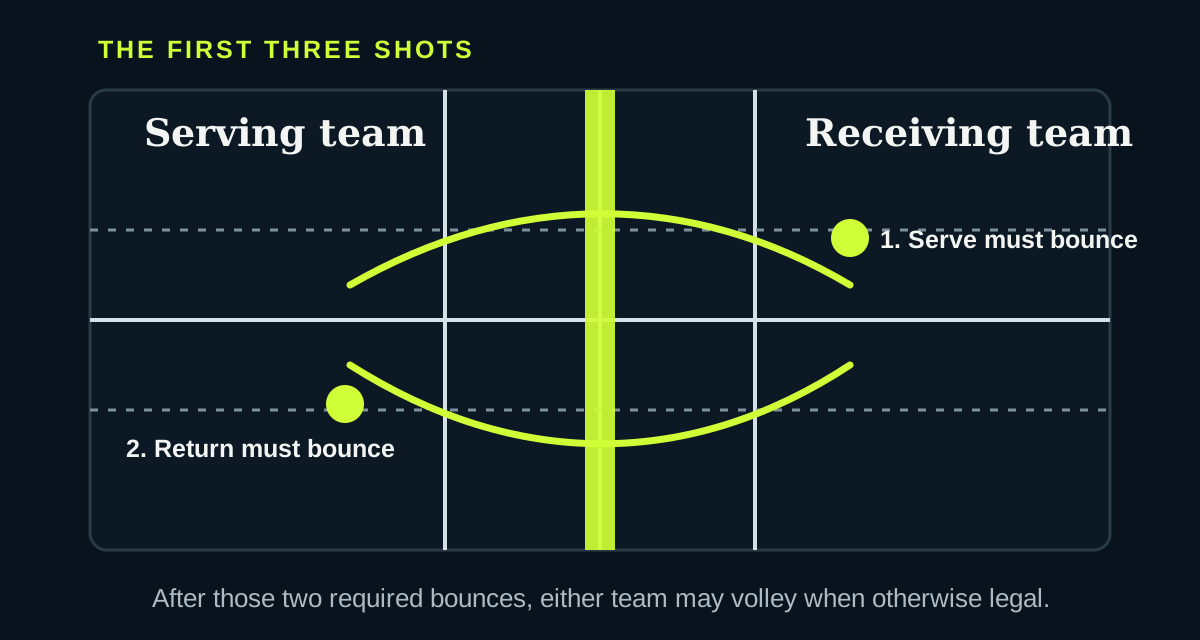
What the two-bounce rule actually requires
USA Pickleball's 2026 rules place the standard two-bounce rule in Section 10.A. Its purpose is straightforward: after the serve, each team must make one groundstroke before either team can volley.
That creates two required bounces in total:
| Shot | What must happen | Can it be volleyed? |
|---|---|---|
| 1. Serve | The serve travels to the receiver's service court. | No — the receiving team must let it bounce. |
| 2. Return of serve | The receiver returns the ball after the serve has bounced. | No — the serving team must let this return bounce. |
| 3. Serving team's next shot | The second required bounce has now occurred. | Yes — the ball may be volleyed or played after a bounce. |
| 4th shot onward | The two-bounce requirement has been completed. | Yes, subject to the non-volley-zone and other rules. |
It does not mean “two bounces on each side”
The name causes unnecessary confusion. The standard rule does not give each team two bounces before returning the ball. It requires one bounce on the receiving team's side after the serve and one bounce on the serving team's side after the return.
In ordinary standing play, once a live ball bounces twice on the same side before being returned, the rally is lost. That is a different concept from the two-bounce rule.
Why pickleball has the rule
USA Pickleball explains that the rule removes the immediate serve-and-volley advantage and helps extend rallies. Without it, the serving team could attack the return out of the air before the rally had properly developed.
The rule therefore shapes the first three shots of almost every standard rally: a serve, a groundstroke return, and then the serving team's third shot.
Common situations
| Situation | Ruling |
|---|---|
| The receiver volleys the serve before it bounces. | Fault. The serve must bounce before the receiving team returns it. |
| The receiver lets the serve bounce, returns it, and the serving team volleys that return. | Fault. The return must bounce on the serving side first. |
| Both required bounces have occurred and the serving team volleys the third shot from outside the kitchen. | Legal, assuming no other rule is violated. |
| The return of serve lands in the kitchen. | Legal. The serving team must let it bounce, then may play it after the bounce. |
| The serve clips the net but lands legally. | The serve remains live; the receiving team must still let it bounce. |
| After both required bounces, a player volleys while touching the non-volley zone. | Fault. Completing the two-bounce sequence does not override the kitchen rule. |
The kitchen rule and the two-bounce rule are separate
This is one of the most useful distinctions for beginners. The two-bounce rule controls when volleys first become available in a rally. The non-volley-zone rule controls where a player may stand while volleying.
So after the serve and return have each bounced, volleys are generally permitted — but a player still cannot volley while touching the kitchen or its boundary line, and momentum from a volley cannot carry the player into the non-volley zone.
Read the kitchen rule in full →
Edge cases that change the call
Does the return of serve have to bounce in a particular area?
No special “return box” exists. Once a legal serve has bounced and been returned, the return may land anywhere that would otherwise be in bounds on the serving team's court. It can be deep, short or in the kitchen. Wherever an in-bounds return lands, the serving team must allow that return to bounce before playing it.
Can the third shot bounce too?
Yes. The two-bounce rule does not require a volley on the third shot; it merely makes a volley permissible after the first bounce on each side has occurred. In practice, many third shots are intentionally played after a bounce — including the familiar third-shot drop.
What if the first or second required ball is going out?
You do not need to let an out ball bounce merely to “complete” the two-bounce sequence. If the serve is out, the rally ends. If the return of serve lands out, the rally also ends. The two-bounce rule governs how a live rally proceeds; it does not rescue an out ball.
Is the “two-shot rule” the same as the two-bounce rule?
Usually, yes. “Two-shot rule” is informal shorthand for the opening requirement: the receiving team must play the serve after a bounce, and the serving team must play the return after a bounce. USA Pickleball's rulebook calls it the Two-Bounce Rule.
Is it the two-bounce rule or double-bounce rule?
USA Pickleball uses Two-Bounce Rule for this opening-rally requirement. “Double bounce” is easy to misunderstand because a ball bouncing twice on one side before being returned is ordinarily a fault. Pickleball Cosmos therefore uses the governing body's terminology.
A 2026 exception worth knowing: adaptive play
There is an important reason not to write that “two bounces on one side are always illegal.” Separate adaptive rules can modify the normal maximum-bounce rule.
USA Pickleball's adaptive guidance allows wheelchair players two bounces before returning the ball; a third bounce produces the fault. For 2026, USA Pickleball also approved a two-bounce allowance option for qualifying adaptive standing players who meet the eligibility rules and declare the option before the match. The 2026 adaptive-standing provisions specifically modify the standard maximum-bounce rule.
Quick answers
When can you start volleying in pickleball?
After the serve has bounced on the receiving side and the return has bounced on the serving side. From the third shot onward, either team may volley when otherwise legal.
Can the third shot be a volley?
Yes. Once the return of serve has bounced on the serving team's side, the two-bounce requirement is complete. The third shot can be volleyed if the player is in a legal position.
Can the return of serve land in the kitchen?
Yes. The kitchen restriction concerns volleying; it does not make a bounced return illegal. The serving team must let that return bounce before playing it.
Does the two-bounce rule apply in singles?
Yes. The opening sequence is the same: the receiver lets the serve bounce, then the server lets the return bounce.
Does a net serve change the rule?
No. If a serve touches the net but otherwise lands legally, the ball remains live and the receiver must allow it to bounce.
The easiest way to remember it
Do not memorize “two bounces” in the abstract. Memorize the first three shots:
Serve bounces. Return bounces. Then open play.
That sequence captures the standard rule without suggesting that either side is allowed two bounces.
Primary sources
- USA Pickleball — 2026 Official Rulebook and Rules Summary
- USA Pickleball — Adaptive Pickleball Resources
- USA Pickleball — 2026 Adaptive Standing Two-Bounce Rules
Rule references checked against USA Pickleball's 2026 materials on August 10, 2026. The Official Rulebook controls in sanctioned play.